Beyond the Hype: The Real Truth Behind the 95% Gen AI Failure Rate
Prasanth Sai
Updated
7 min read
Share:
A recent MIT report, “The GenAI Divide: State of AI in Business 2025,” sent shockwaves through the tech world with a startling headline: 95% of generative AI projects in enterprises fail to deliver a return on investment. This statistic quickly became fodder for a narrative of disillusionment, with many developers and commentators on platforms like X (formerly Twitter) and YouTube proclaiming that AI is an overhyped bubble, impractical for real-world applications. However, a deeper analysis of the report reveals a more nuanced and ultimately more optimistic story. The problem isn’t the technology itself, but the enterprise approach to implementing it. This gap in execution has created a significant opportunity for agile startups to lead the way.
This article deconstructs the MIT report, combining its core findings with insights from industry experts to provide a clear analysis of why enterprises are struggling and how a different approach can unlock the transformative potential of generative AI.
The GenAI Divide: Key Findings from the MIT Report
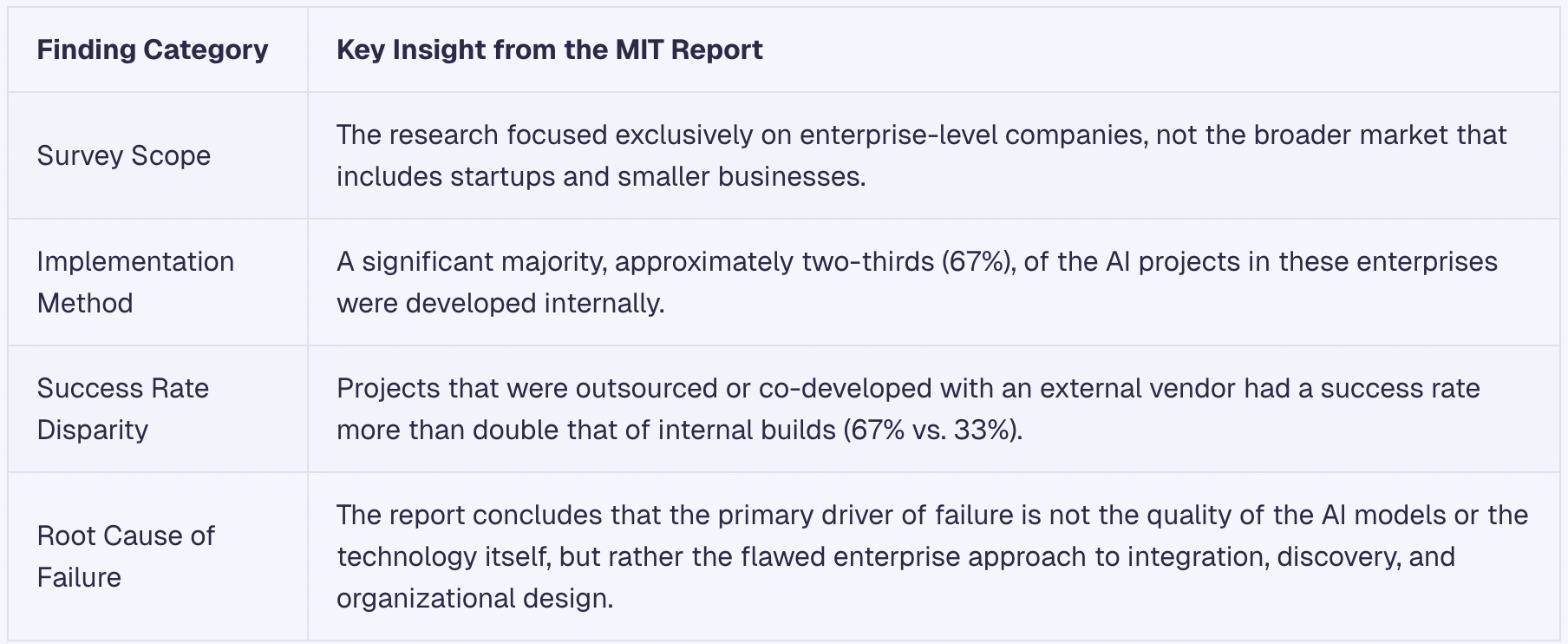
The sensational 95% failure rate, while attention-grabbing, obscures the critical details of the research. The study, analyzed over 300 public AI deployments and included interviews with 52 organizations.
Enterprises and AI’s Limitations
To appreciate why enterprises are facing this challenge, it’s essential to understand both the typical enterprise environment and the inherent limitations of current AI technology.
The Enterprise Ecosystem
Enterprises often operate within a complex and often rigid technological landscape. Decades of development have resulted in what can be described as “bloated software,” characterized by legacy designs and architectures. Many have partnered with large vendors to build custom solutions that are difficult to modify without the original vendor’s involvement, or they have deployed SaaS solutions and built intricate custom layers around them. This creates a highly complex ecosystem of interconnected systems and workflows, making it difficult for new innovations to be integrated seamlessly. Internal engineering teams are frequently siloed, focused on maintaining their specific component of this complex machinery, which can stifle broader, more decentralized innovation.
The Limitations of Current AI Technology
While generative AI is powerful, it is not a magic bullet. Current agentic systems face several key limitations. The “context window” problem, analogous to the relationship between a computer’s RAM and its hard drive, means that AI models can only process a limited amount of information at any given time. Furthermore, these systems are probabilistic, not deterministic; they generate responses based on patterns in their training data, which can sometimes lead to inaccuracies or “hallucinations.”
Because of these limitations, context engineering is paramount. For business-sensitive and complex use cases, managing and providing the right context to the AI is extremely important and difficult. This is why most successful AI solutions today function as assistants or co-pilots, augmenting human capabilities rather than directly implementing tasks without supervision.
The Flaws in the Enterprise Approach
With the context of the enterprise environment and AI’s limitations in mind, we can now examine the major problems with the current enterprise approach as highlighted by the MIT report and my own observations.
1. The Discovery and Budgeting Problem
The MIT report found that over 50% of enterprise AI budgets are allocated to front-office processes, such as sales and marketing. While the ROI in these areas is often easier to measure and more visible to executives, the report also notes that the most significant and dramatic cost savings often come from back-office automation. By focusing so heavily on front-office use cases, enterprises are missing out on high-impact opportunities to streamline operations, reduce external vendor spending, and cut BPO licensing costs. A more balanced approach, perhaps starting with a 70/30 split in favor of back-office projects, could generate measurable savings that can then be used to self-fund more ambitious front-office initiatives.
2. The Challenge of Workflow Integration
The report identifies the inability to integrate AI into critical workflows as a primary barrier to success. As one Forbes analysis put it, pilots that “glide frictionless from demo to deployment never build the muscle to scale” and “collapse the moment they hit real organizational texture, compliance, politics, data quality, and human judgment”. Enterprises often try to layer AI on top of existing, often broken, workflows, which is a recipe for failure. True transformation requires a willingness to redesign processes from first principles, a step that many large organizations are hesitant to take.
3. The Lack of Adaptive and Flexible Systems
A recurring theme in the MIT report is the “learning gap.” The most common reasons cited for pilots failing were that the tools “break in edge cases and don’t adapt” and “don’t learn from our feedback”. Users, accustomed to the continuous improvement of consumer-grade AI like ChatGPT, are quickly frustrated by enterprise tools that are static and require extensive manual context for each use. The most successful AI implementations are those that create a feedback loop, allowing the system to learn with supervised approvals. This creates a powerful flywheel effect and significant switching costs once a system has been trained on an organization’s specific workflows.
4. The Vendor Partnership Misstep
Enterprises often default to partnering with their incumbent, large-scale existing vendors for new AI initiatives. However, these vendors are often guilty of simply “slapping AI” onto their existing platforms without rethinking the product from an AI-native perspective. This approach fails to leverage the unique capabilities of generative AI and often results in clunky, ineffective solutions. In contrast, startups are building products from the ground up with an AI-first mindset, leading to more innovative and effective solutions.
5. The Need for a New Organizational Structure
Finally, the traditional, centralized IT model is ill-suited for the dynamic and experimental nature of AI development. The MIT report suggests that a more effective approach is a decentralized model that empowers frontline managers and individual contributors to source and champion AI initiatives. This bottom-up approach, combined with executive accountability, can accelerate adoption and ensure that solutions are grounded in real-world needs. From my experiences, enterprises should adopt an AI operating model that functions like a venture fund, incubating ideas with structured measurement and governance while keeping data privacy at the forefront.
The Golden Opportunity for Startups
This enterprise-wide struggle to adapt has created a golden opportunity for startups. The very reasons enterprises are failing are the reasons startups are succeeding. Startups can:
Build AI-native products from a clean slate, unencumbered by legacy systems.
Move with speed and agility, embedding themselves within a customer’s workflow to solve specific, high-value problems.
Attract top talent that is passionate and has deep conviction in the power of AI.
Partner with enterprises that are now, more than ever, willing to look outside their traditional vendor relationships for solutions that actually work.
The MIT report’s finding that external partnerships are twice as successful as internal builds is the clearest signal of this opportunity. Startups that can demonstrate a deep understanding of a specific domain and deliver a product that learns and adapts are finding a receptive audience in enterprises that have been burned by failed internal projects and lackluster offerings from incumbent vendors.
Conclusion
The narrative that “95% of Gen AI projects fail” is not an indictment of the technology, but a reflection of the enterprise’s struggle to adapt its processes, culture, and organizational structure to a new technological paradigm. For enterprises, the path forward requires a fundamental shift in mindset. For startups, the path forward is clear: the enterprise AI market is ripe for disruption, and those who can bridge the GenAI Divide will be the winners of the next technological era.
Comments
Leave a Comment
No comments yet. Be the first to comment!
Written by Prasanth Sai
Gen AI Product Leader · Leads AI Applications and Search at eGain
I partner with PMs and engineers to drive production adoption of AI across Fortune 500 enterprises in the US and Europe. IIT Bombay alumnus; previously co-founded Selekt.in and built ChatGen.ai. The thesis I evangelize: knowledge is the harness for AI applications.
Enjoyed this article?
Explore more insights on Gen AI, product leadership, and enterprise AI transformation.